🎓 Read a school-season, then solve the roster
16-0 is the college football counterpart to the 20-0 game. Its offered identities belong to schools and college seasons. A familiar professional name can help recognition, but the college version still needs to be read on its own terms.
Which program supplies the current pool?
Which offered season belongs to this card?
Which legal destination needs an answer now?
Those questions keep a professional-career memory from quietly replacing the evidence on the college card. They also make an unfamiliar school less intimidating: you can inspect the listed contribution before claiming to know every player.
The Missouri pool provides a concrete QB comparison
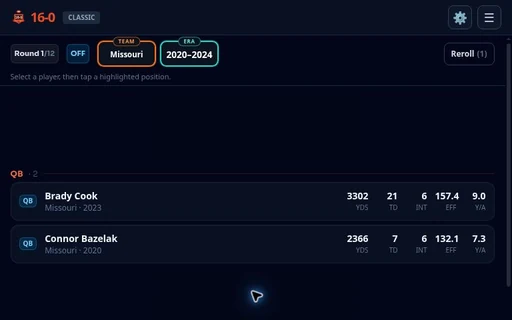
The captured Brady Cook card shows 3,302 passing yards, 21 passing touchdowns, six interceptions, 157.4 efficiency, and 9.0 yards per attempt. The pool also offers Connor Bazelak, whose listed fields differ.
Read EFF as the college passing-efficiency field shown here. Do not silently equate it with the pro passer-rating field used on a different football card or add it to a yardage count.
The screenshot records one offered college version. It is not a promise that Missouri, Cook, or the same historical window will appear in your next unrestricted draft.
What the two offered Missouri versions establish
| Field | Brady Cook | Connor Bazelak | Supported description |
|---|---|---|---|
| Passing yards | 3,302 | 2,366 | Cook leads the displayed passing total. |
| Passing touchdowns | 21 | 7 | The passing-touchdown figures differ by fourteen. |
| Interceptions | 6 | 6 | The recorded interception totals match. |
| Efficiency | 157.4 | 132.1 | Cook leads the displayed college efficiency measure. |
| Yards per attempt | 9.0 | 7.3 | The per-attempt figures differ as well. |
Cook leads the passing-yard total by 936 and passing touchdowns by fourteen, while interceptions match. Classic lets you inspect that line; the underlying college player rating remains hidden. You still need the other eleven placements after choosing the quarterback.
🏟️ The roster still asks for both sides
Offense
QB · RB · WR · TE · FLEX · FLEX
One card per selection, with fixed skill roles and two shared destinations.
Defense
EDGE · DT · LB · CB · S · D-FLEX
Distinct defensive jobs and one additional shared defensive place.
The standard full draft fills offense before defense. The familiar shape does not make the school-season data interchangeable with the pro-football pool. Keep college achievements, offered versions, and the current eligible roles attached to each choice.
The standard resource description provides one reroll per side. Inspect the current counter before treating an earlier resource as available again.
A school pool is more than its most famous quarterback
The observed Missouri offer also contains runners such as Cody Schrader, Larry Rountree III, Nate Noel, and Tyler Badie. That broader pool matters because selecting the quarterback leaves other offensive jobs unresolved.
You do not need to turn the page into a fixed list of names to memorize. Ask which available card answers a remaining requirement and which role would still be open after a shared placement.
The unexpanded board shows how multiple candidates coexist. It illustrates an opportunity to inspect, not a recommended final roster.
📒 Check the claim before using the memory
The exercise changes the evidence question. It does not reveal a hidden rating or decide a real draft for you.
Sixteen undefeated games define this edition’s goal
The game’s target is a complete 16–0 college championship run. Read that target as the edition’s own simulation goal. It is not the pro game’s seventeen-plus-three route with a different heading.
The published evaluation also considers college honors alongside the statistical line. That is a reason to avoid reverse-engineering the entire assessment from a single visible total. An offered player can have relevant season context beyond the short row you first notice.
After the final defensive placement, read the completed college record and grade. The school’s reputation is not a substitute for that projection. A remembered NFL career also cannot change the school-season fields the draft actually offered.
Bring the process across without importing the wrong identity
When you return to the 20-0 game, carry the habit of checking the offered version. Leave college-specific performance and school identity attached to the college card where they belong.
The context comparison explains why raw totals need a careful question, while the football shared-slot examples help with the familiar vacancy problem. For another kind of roster puzzle, try basketball’s fixed starting five or baseball’s lineup and pitching staff. Read each game’s own labels before committing.