🏀 Five jobs make a basketball lineup
98-0 takes the roster-building idea into basketball. If you arrived from the 20-0 game, the first adjustment is to stop looking for football destinations: the standard starting-five draft needs PG, SG, SF, PF, and C.
Each round offers a team-and-era pool. Inspect a player-season, select it, and choose a legal open destination. Multi-position labels can make a card usable in more than one place, but the starting-five format does not supply football-style FLEX slots.
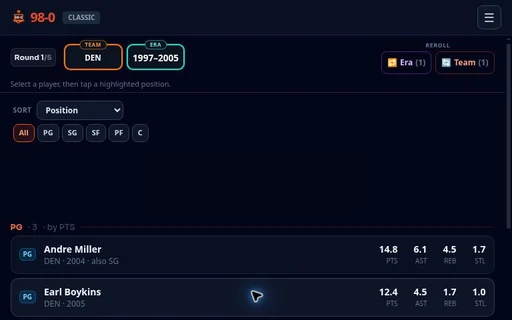
The player above opens Classic in the starting-five scope. A separate Full Squad option can change the roster problem; keep the chosen scope attached when comparing results.
Miller gives the guard comparison more than a points column
The captured Denver Andre Miller card reports 14.8 points, 6.1 assists, 4.5 rebounds, and 1.7 steals. It also explicitly offers SG eligibility alongside PG.
Those fields describe several forms of contribution. They do not make 14.8 a team score or establish that every lower-scoring guard is weak. Read the offered season and the category before letting a career reputation finish the comparison.
The highlighted destinations show where the selected card can go in this board state. That is useful flexibility, not permission to place it at every basketball position.
Compare two guards without erasing their differences
| Displayed field | Andre Miller | Nick Van Exel | Observation |
|---|---|---|---|
| Points | 14.8 | 17.7 | Van Exel leads the displayed scoring average. |
| Assists | 6.1 | 8.5 | Van Exel also leads the assist figure. |
| Rebounds | 4.5 | 3.4 | Miller leads the rebound figure. |
| Steals | 1.7 | 0.9 | Miller leads the recorded steal figure. |
| Additional role | SG | SG | Both offer a second guard destination. |
Van Exel leads the listed scoring and assist averages; Miller leads rebounds and steals. Keep those categories attached rather than counting two wins for each card. The underlying game rating stays hidden even when Classic exposes the stat line.
🔄 The two rerolls change different parts of the offer
Era reroll
Keep the team and change its era. Use the decision to examine the historical window rather than imagining another franchise will appear.
Team reroll
Keep the era and change the franchise. This asks a different opportunity question from replacing the historical window.
The observed control provides one of each. Treat them as separate resources and read their current counters. The standard football rule of one reroll per side is not the basketball rule described here.
Before spending either, name the remaining job. A pool that cannot answer your fixed center vacancy presents a different problem from one that simply lacks your favorite scorer.
For example, with C still empty, a team reroll changes the franchise but keeps the era; an era reroll changes the window but keeps the team. Those are different searches for a legal center. Decide which part of the current offer is the problem before choosing the resource.
McDyess illustrates a different production profile
The captured Antonio McDyess card reports 20.8 points, 12.1 rebounds, 1.5 blocks, and 2.1 assists. The offered PF card also lists C eligibility.
That can matter when both frontcourt destinations remain open. Spending a versatile big at one position changes the vacancy left for a later candidate, even though the player’s statistical line has not changed.
Do not compare the guard and the big by simply counting who leads more columns. Their roles, eligibility, and the lineup’s remaining needs differ.
🧩 Check the two captured cards’ legal roles
The name includes the championship sweep
The undefeated route combines an 82-game regular season with sixteen playoff wins. That is the full 98-win target, rather than only an excellent regular-season record.
A starting-five roster should therefore be judged as a complete set of contributions. One spectacular scorer does not remove the other four requirements. The published standard weights give PG 1.15 and C 1.1, with the other starting places at 1.0; those weights are not probabilities of scoring or winning.
Read the finished record and grade directly. An impressive collection of names or a large individual average does not certify a flawless title run.
Carry the decision habit across sports, with the right rules
Keep basketball’s five named jobs beside the offer. Miller’s PG/SG access and McDyess’s PF/C access are useful because they leave different vacancies after placement. That is the transferable lesson from the 20-0 game; the actual destinations and rerolls here belong to basketball.
Try college football for a school-based roster or baseball for a lineup-and-staff problem. Return to the football result guide only when reviewing the corresponding football screen. Similar presentation does not make every sport the same experiment.