⚾ Build a lineup and a staff, not twelve interchangeable bats
162-0 turns the roster challenge into baseball. Coming from the 20-0 game, the major adjustment is to track field positions and pitching roles separately. A strong hitter does not fill a starting-pitcher vacancy.
The standard configuration has nine lineup destinations and three pitching places. Full Rotation keeps the lineup and expands the staff to four starters and two relievers. Choose the roster size deliberately before comparing completed runs.
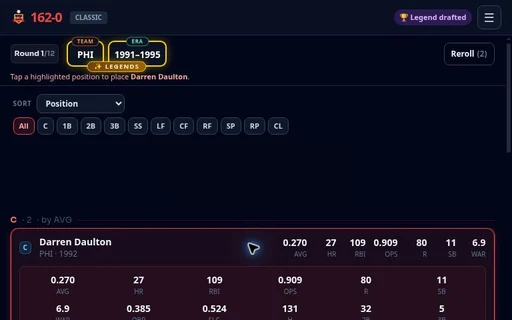
The player above opens the standard Classic route. Read explicit positional eligibility on each offered card; a famous bat does not automatically belong at every fielding position.
Daulton’s batting line answers several different questions
The captured Philadelphia Darren Daulton card reports .270 batting average, 27 home runs, 109 RBI, .909 OPS, 80 runs, 11 stolen bases, and 6.9 WAR. The expanded view adds more batting detail.
AVG and OPS are rate measures; HR and RBI are totals. Read the batting line in those separate units. Classic exposes the statistics, while the game’s underlying overall rating stays hidden. Daulton’s .909 OPS is not that hidden rating.
The card is offered at catcher. Selecting it highlights legal places, including the general DH destination; that does not turn it into a legal answer for an unrelated infield position.
Read batting and pitching in their own units
| Reading question | Relevant evidence | Boundary |
|---|---|---|
| How is a batter reaching and advancing bases? | AVG and OPS, with the underlying batting fields when available. | A rate is not an accumulated total. |
| What power production is recorded? | HR and related extra-base detail. | A home-run lead does not settle every part of the batting profile. |
| What run prevention does a pitcher show? | ERA and WHIP with workload context. | A short workload and a long workload are different opportunities. |
| What pitching dominance is recorded? | Strikeouts and the innings carried. | A strikeout count alone does not isolate every efficiency question. |
| Can the candidate solve the vacancy? | Listed fielding or pitching eligibility. | A good statistical line does not create a new legal position. |
Schilling makes the pitching side visible
The observed Curt Schilling card lists 2.35 ERA, 14 wins, 147 strikeouts, 0.99 WHIP, 226.3 displayed innings, and 5.9 WAR. It is offered as SP with additional RP eligibility.
The screenshot prints 226.3 in its IP field. Do not read that automatically as baseball’s innings-and-outs notation: conventional .1 and .2 represent one and two outs, while a numeric game display can use a different representation. Establish the field’s definition before deriving a rate from it.
The SP/RP labels matter when planning the remaining staff. A versatile pitcher can answer different legal roles, but choosing one destination changes the specific place left for another arm.
🧮 Count the requirements for the selected configuration
This is a roster-requirement reference, not a draft simulator. It helps keep a twelve-player comparison separate from a fifteen-player one.
Spend the shared reroll budget with the staff still in mind
The standard baseball description provides two rerolls for the run, shared across lineup and staff decisions. That differs from football’s side-specific standard budget and basketball’s separate team and era resources.
Before spending a reroll on a merely less familiar batting pool, check what useful legal answers it already contains. Preserving a resource can matter when the remaining pitching problem is harder to solve.
Likewise, DH is broad batting space, not a reason to ignore fixed fielding jobs. If you spend it early, record which specific defensive position must still be answered by a later hitter. A collection of strong bats still needs a complete lineup.
The regular-season name is followed by an October target
The flawless route therefore reaches 173 wins after the postseason sweeps. A perfect regular season and a flawless title run are separate achievement boundaries. Read the finished screen instead of treating the game’s short name as the entire postseason record.
The diagram explains the target. It is not a fabricated result from the captured Philadelphia cards.